
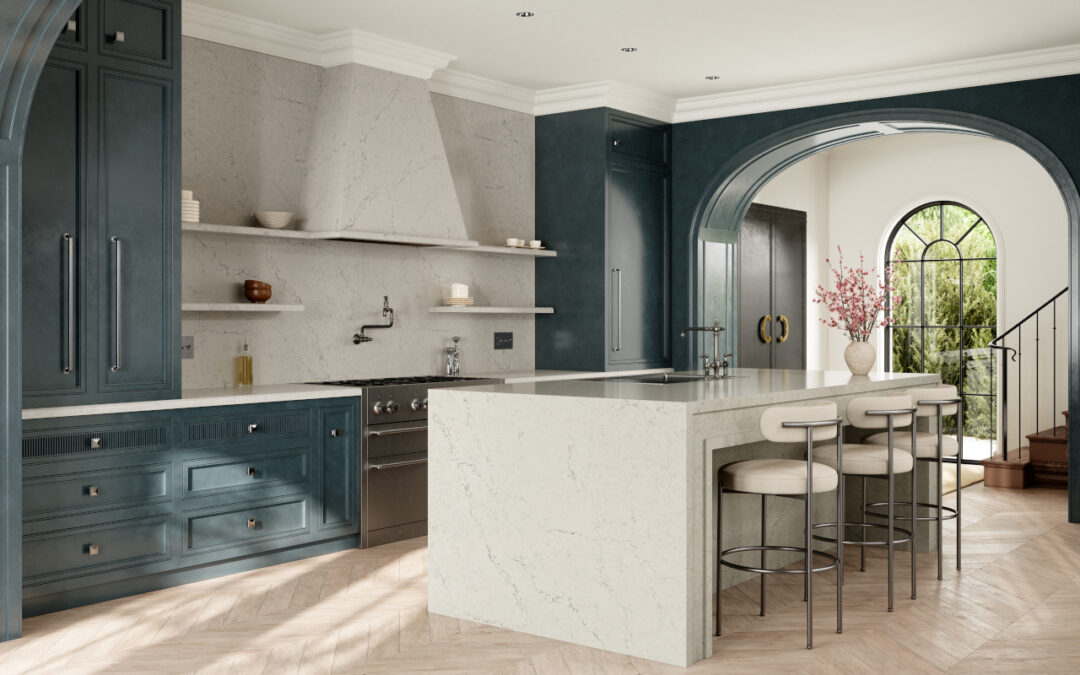
Picking cabinets and countertops isn’t about finding two things you like separately. You need to understand how they interact through contrast, undertone, and surface texture.
Get all three right and the pairing will feel considered and built to last. Miss even one, and no amount of great hardware or backsplash tile will fully fix it.
This article explains the three core design principles behind every strong cabinet-countertop pairing, applies them color by color (white, gray, dark/navy, natural wood), adds the door style dimension most design guides overlook, and includes a quick reference table with our designer’s recommendations.
Want expert kitchen remodel advice? Head to our Elevations Design Studio →
Key Takeaways
- Every successful cabinet-countertop pairing comes back to three principles: contrast level, undertone harmony, and finish texture.
- White and light cabinets pair best with countertops that add warm or movement.
- Dark and navy cabinets need light countertops to offset visual weight.
- Cabinet door style (shaker, raised panel, flat-front) also affects countertop texture choice.
- 96% of designers identify warm neutrals as the dominant kitchen color, with greens (86%) and blues (78%) gaining ground as accent tones, according to NKBA’s 2026 Kitchen Trends Report.
What Are the Three Design Principles for Cabinet and Countertop Pairings?
Every cabinet-countertop combination comes back to three things: contrast level, undertone harmony, and finish texture. All three have to work together.
- Contrast level is how light or dark the cabinet and countertop are relative to each other. High contrast creates visual definition and energy. Low contrast reads as calm and cohesive, but risks falling flat without textural variation to compensate.
- Undertone harmony is the difference between a warm gray and a cool gray. Every cabinet color and countertop surface carries a warm or cool bias. Pairing a warm-undertoned cabinet with a cool-undertoned countertop, or vice versa, produces a result that registers as “off,” even if you can’t immediately name why.
- Finish texture refers to how much visual activity each surface brings to the space. A detailed cabinet door already introduces texture, as does a heavily veined countertop. Layer too much and the eye has nowhere to rest. Layer too little and the kitchen may read as cold and clinical.
|
Design Tip Even a strong material combination can look different in your space than it did in the showroom. Bring samples home before you finalize anything. |
Cabinet and Countertop Pairing Quick-Reference Table
| Cabinet Color | Door Style | Best Countertop Match | What to Avoid |
| White | Shaker | Warm veined quartz, marble-look | Cold, flat pure white |
| Warm Gray | Raised panel | Cream or greige quartz | Cool gray |
| Cool Gray | Flat-front | White or cool-veined quartz | Warm beige |
| Dark/Navy | Shaker or flat-front | Light quartz, marble look | Dark or visually busy stone |
| Natural Wood | Any | Neutral quartz, contrasting dark stone | Competing wood-look surfaces |
What Countertop Works Best With White Cabinets?
Warm-veined quartz, marble-look surfaces, and butcher block are the strongest countertop pairings for white cabinets. The most common mistake is reaching for a cold, flat white surface that too closely matches the cabinet tone. This makes a kitchen look blank rather than bright.
The countertop’s job alongside white cabinets is to contribute something the cabinet doesn’t already provide: warmth, movement, or depth. Warm-veined quartz with cream, gold, or taupe variation accomplishes all three while keeping the overall space light and open.
What does that look like in a material? Cambria has quartz with soft veining and warm undertones well-suited for white cabinetry pairings. For projects with tighter budgets, Wilsonart carries marble-look and warm stone-look laminate countertops that also pair well.
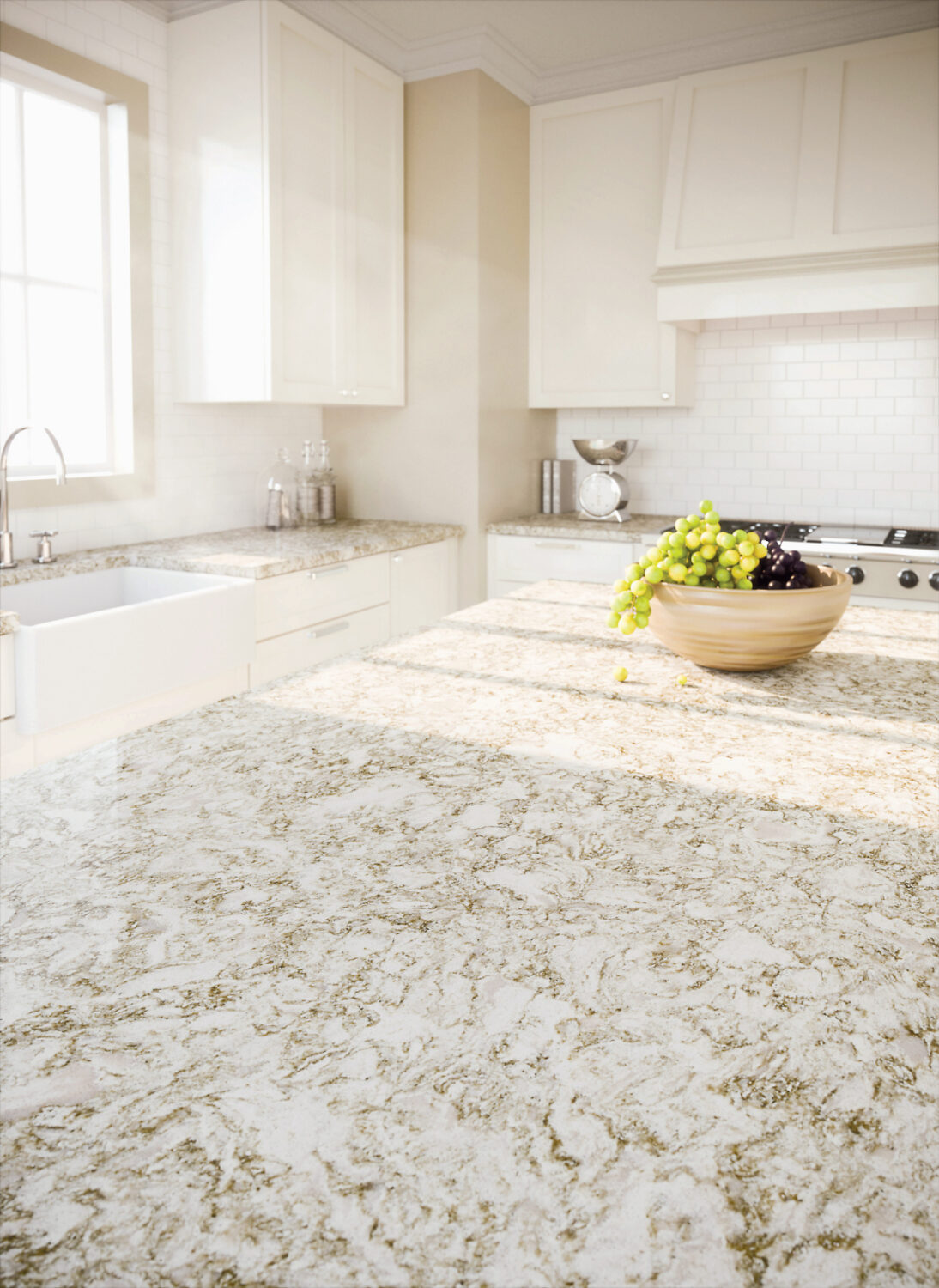
Pictured: Cambria Crowndale™
Read more about countertop colors for white cabinets →
What Countertop Works Best With Gray Cabinets?
For gray cabinets, the countertop decision depends on one variable above all others: whether your gray runs warm or cool.
- Cool gray cabinets carry blue or green undertones. They pair well with white, off-white, or cool-veined quartz that stays in the same temperature range. Wilsonart also has cool-toned solid surface and laminate patterns that work particularly well in this scenario.
- Warm gray cabinets carry beige or taupe undertones. They pair best with cream, greige, or warm quartz.
How to Tell if a Gray is Warm or Cool
Hold the cabinet sample next to a white sheet of paper. If it reads bluish or greenish, it’s cool. If it reads beige or brown, it’s warm. Match your countertop to that temperature.
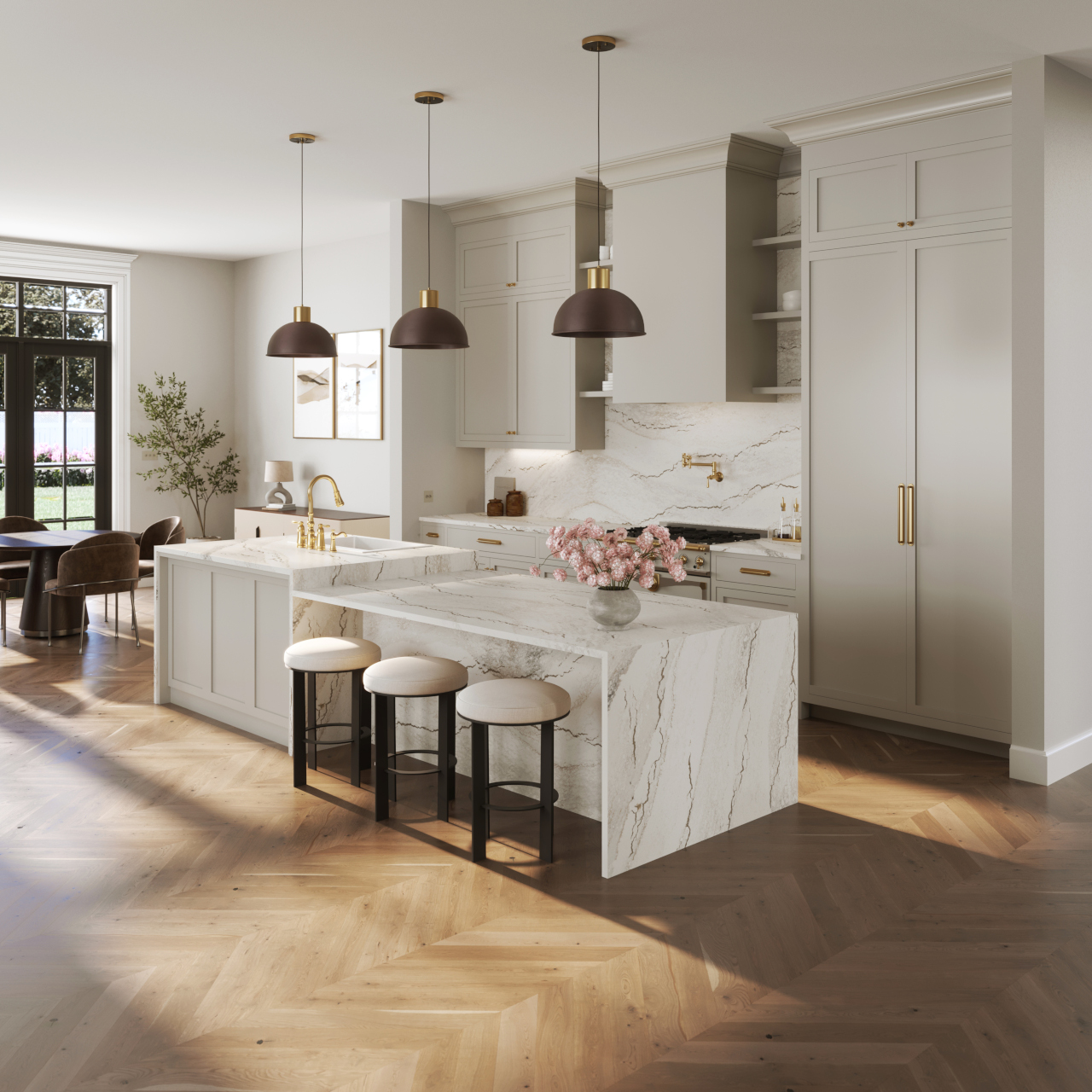
Pictured: Cambria Inverness Blakeley™
What Countertop Works Best With Dark or Navy Cabinets?
Light countertops (crisp white, soft cream, or lightly veined quartz) are the right choice for dark or navy cabinets. The countertop’s role in this pairing is contrast: to lift the space visually and let the cabinet color make the statement it’s built to make.
Dark countertops on dark cabinets can work in a deliberately moody, high-design context with excellent lighting, but it’s a narrow runway and an easy place to end up with a kitchen that feels enclosed rather than dramatic. A more forgiving direction would be lightly veined quartz with warm movement (gold, taupe, cream tones) that picks up hardware finishes and adds character without competing with the cabinet color.
Heavily patterned or busy stone also creates problems against dark cabinetry. The eye needs a clear place to rest, and a bold cabinet color already fills most of the visual field. Cambria’s lighter quartz options offer the right balance of surface interest and visual restraint for dark cabinet pairings.
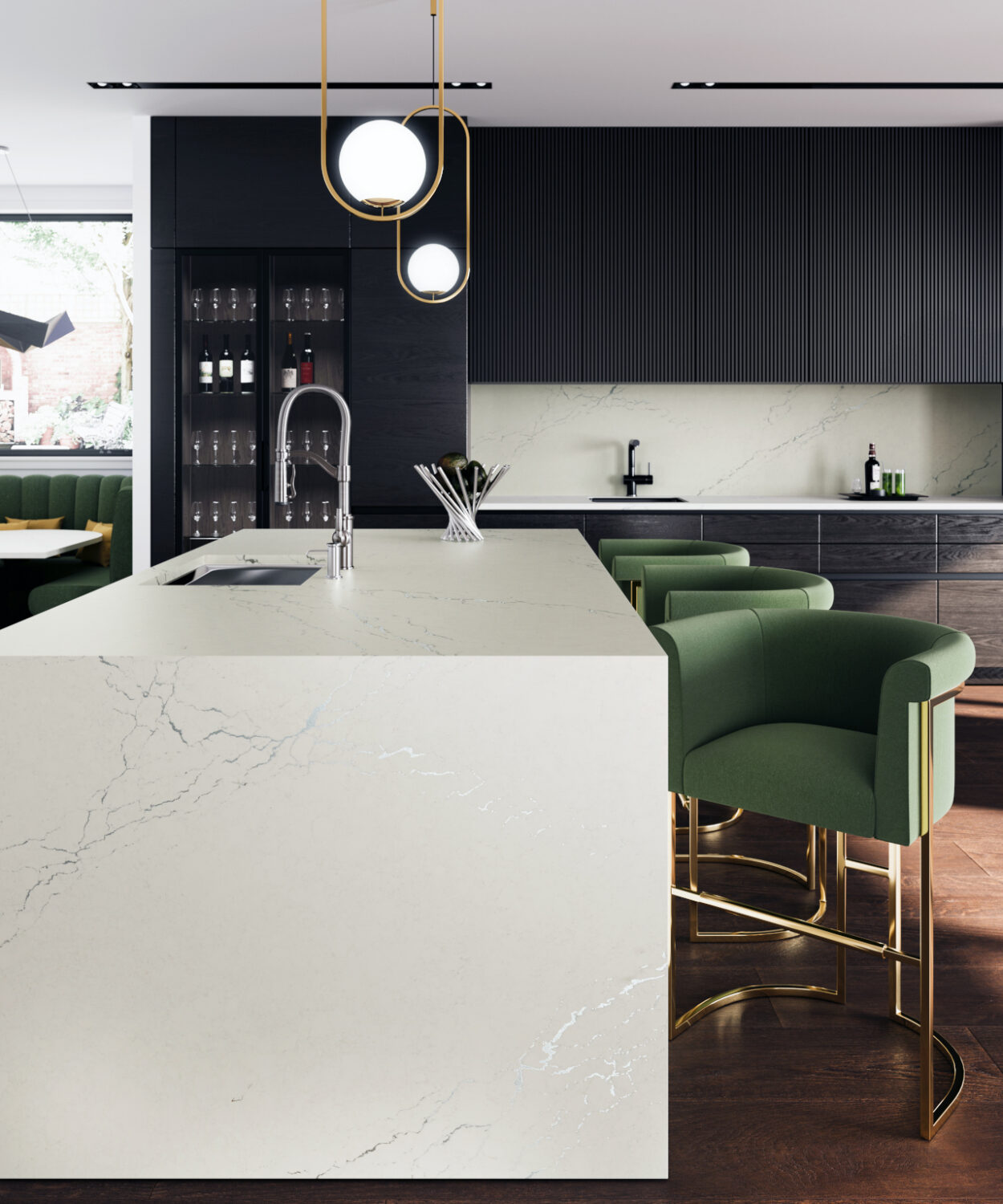
Pictured: Cambria Berkshire Steel Sculpted™
What Countertop Works Best With Natural Wood or Stained Cabinets?
Neutral or contrasting countertops work best with natural wood and stained cabinetry. Wood is inherently warm, which gives you two design directions: extend the warmth, or balance it with contrast.
- To extend warmth: Choose a quartz in soft white, greige, or warm cream. The countertop stays understated, the wood leads, and the result tends to read as timeless and grounded.
- To create contrast: Pair the wood with a dark stone or deep-toned countertop. This works especially well with lighter-stained woods, where the contrast grounds the kitchen without fighting the natural grain.
The pairing to avoid is a wood-look countertop surface alongside wood cabinets. Two wood textures competing in the same horizontal plane create visual noise without adding depth or dimension.
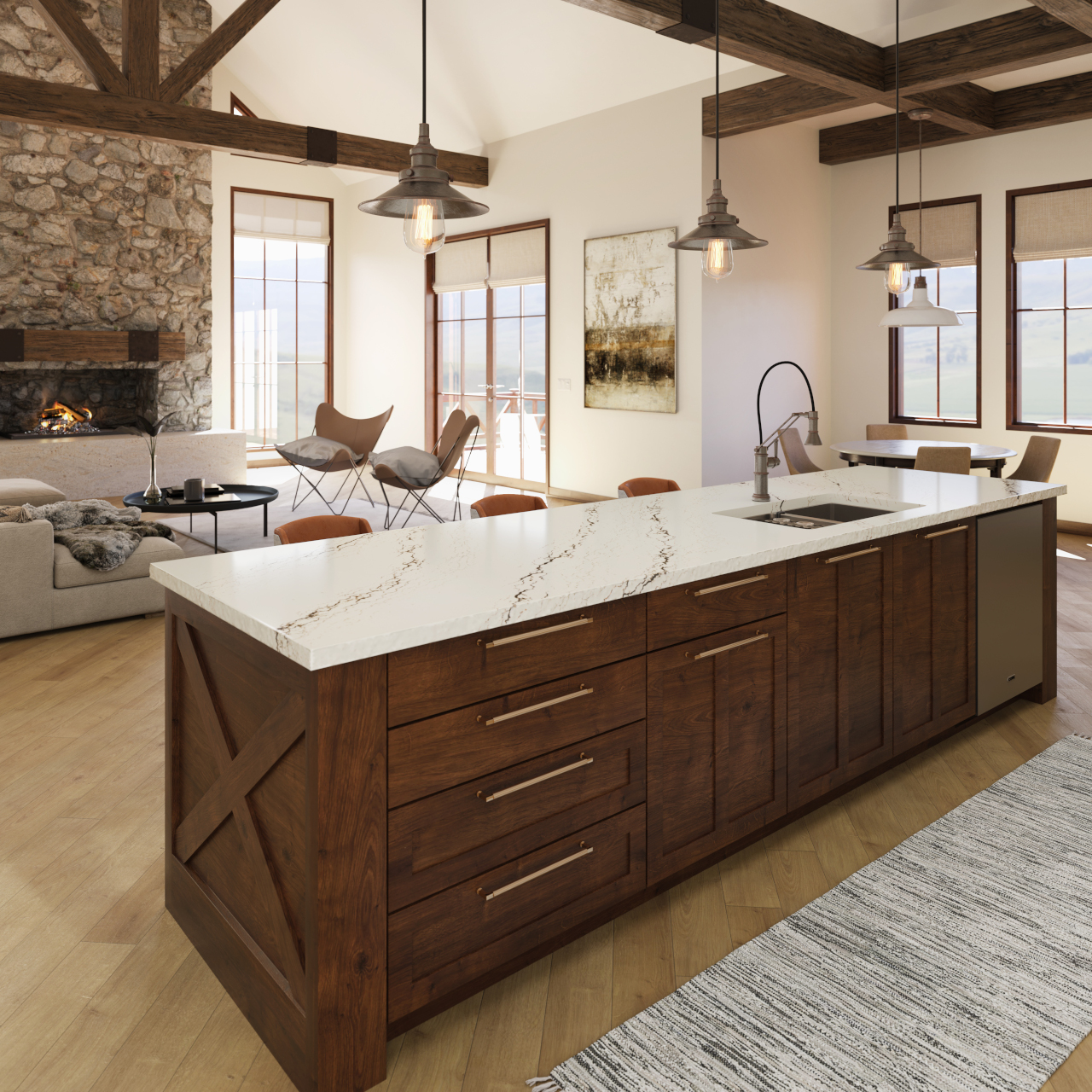
Pictured: Cambria Notting Hill™
Shopping Cabinets?
Our Ultimate Guide to Purchasing Cabinets covers construction quality, finish options, and style considerations in one downloadable resource. This is a strong starting point before you start pulling countertop samples.
Does Cabinet Door Style Affect Your Countertop Choice?
Yes, cabinet door style determines how much visual texture the cabinet itself brings to the space. That texture has to be balanced against what the countertop contributes.
Shaker Cabinets and Countertop Pairings
Shaker doors have a clean rail-and-panel profile that introduces moderate, linear detail. They’re versatile enough to handle veined quartz, marble-look surfaces, or quieter solid options.
The moderate texture level of a shaker door leaves room for countertop movement. The two surfaces tend to balance rather than compete, which is part of why shaker remains the most popular door style for kitchen renovations.
Raised-Panel Cabinets and Countertop Pairings
Raised-panel doors carry more ornate detailing with curved or layered profiling. They’re already doing a lot of visual work, which means the countertop needs to be quieter. Solid quartz, honed stone with subtle variation, or a low-veining laminate let the door style land clearly without fighting a busy countertop pattern for attention.
Flat-Front or Slab Cabinets and Countertop Pairings
Flat-front or slab doors are deliberately minimal. That minimalism is a design statement that puts the countertop in the position of providing the texture and visual interest the space needs.
A flat slab door against a flat, solid-surface counter produces a sterile result. Veined quartz, textured stone, or a surface with movement restores the balance the space is missing.
|
Brand Recommendation: Yorktowne Cabinetry Yorktowne Cabinetry offers door styles across all three categories, with finish and species options to support any pairing direction. View Yorktowne Cabinets → |
How to Tie a Full Kitchen Remodel Together After Cabinet and Countertop Selections
Once your cabinet-countertop pairing is set, three remaining elements need to reinforce it: hardware, backsplash, and flooring. Their job is to support what you’ve already established.
- Hardware should echo the countertop’s undertone, not the cabinet color. If the countertop runs warm (cream tone, gold or taupe veining), lean into warm metal finishes like brass or aged bronze. If the countertop is cool or crisp white, matte black or brushed nickel stays consistent with the temperature of the surface.
- Backsplash bridges the cabinet and countertop. It should visually connect the two dominant surfaces, not introduce a third competing color family. Pull a tone from the countertop’s veining or run a neutral field tile that sits comfortably between the two anchors without demanding its own attention.
- Flooring grounds the palette. When both cabinet and countertop trend light, a medium or darker floor prevents the kitchen from feeling unanchored. When the cabinet carries strong color, a quieter floor lets the upper elements lead without competing at every layer.
Ready to Plan Your Full Kitchen?
Our DIY Homeowner’s Guide to Kitchen Remodeling can help you plan cabinet selection, countertop materials, and other design decisions in one all-inclusive guide.
Browse Cabinet & Countertop Materials from America’s Favorite Brands
Zeeland Lumber & Supply carries Cambria and Wilsonart countertops, Yorktowne Cabinetry, and more top-name brands in the kitchen remodeling space. Stop into a showroom and chat with our design team that can help you put it all together.
Frequently Asked Questions About Cabinet and Countertop Combinations
Should countertops be lighter or darker than cabinets?
There’s no single rule, but contrast between the two surfaces generally creates a more polished, intentional result than matching tones too closely. Bold cabinet colors paired with neutral countertops are among the fastest-rising design choices.
Do cabinet and countertop undertones need to match?
They don’t need to be identical, but they need to be compatible. Warm-undertoned cabinets can pair with other warm or neutral surfaces.
The combination to avoid is a warm-undertoned cabinet against a cool-undertoned countertop (or the reverse). This creates a visual disconnect that reads as “off” even when both individual pieces are high-quality and attractive.
Can you mix countertop styles in a two-tone kitchen?
Yes, but the same undertone and texture principles that govern any cabinet-countertop pairing still apply. If the island uses a different countertop than the perimeter, the two surfaces need to share either an undertone or a texture family so the combination reads as intentional rather than inconsistent.
What is the 2026 trend for kitchen countertops?
Quartz remains the dominant material choice. The bigger shift in 2026 is in surface expression rather than material: bold veining, warm undertones, and matte or leathered finishes are replacing the flat, bright-white surfaces that defined the previous decade.
As kitchen palettes move toward warmer, earthier tones overall, countertops are following. Surfaces that feel natural and organic rather than engineered and uniform are where the market is heading.
What countertops are going out of style?
Several countertop trends that peaked in recent years are declining. High-gloss polished finishes are giving way to matte and leathered textures, which perform better in high-traffic kitchens and align with the broader move toward natural materials.
Cool gray countertops — the icy, blue-undertoned grays that dominated kitchen design from roughly 2015 to 2022 — are losing ground to warmer, earthier surfaces. Granite has also dropped significantly in designer preference. Butcher block as a primary countertop material is fading as well, though it continues to work as an island accent or secondary surface in the right kitchen context.